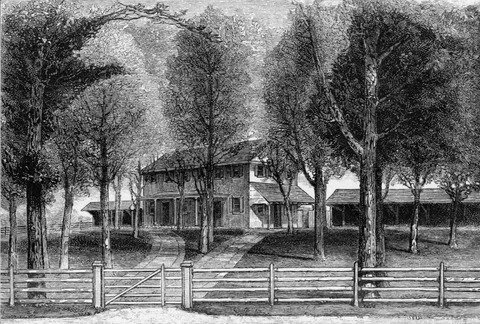
History of the Meetinghouse
AN HISTORIC AND ARCHITECTURAL STUDY OF THE MIDDLETOWN FRIENDS MEETINGHOUSE
Prepared by Jeff Marshall, Bucks County Conservancy, October 1993
The current Middletown Meeting house, which celebrates its two hundredth anniversary, traces its lineage back to the seventeenth century.
The impetus for the construction of a meetinghouse goes back to the time when Bucks County was settled by Friends who took advantage of William Penn’s “Holy Experiment” in Pennsylvania. Most of the people who settled Philadelphia and the surrounding counties were English Quakers. At first, their meetings in Bucks County were held in private homes. Business meetings were held in Burlington, New Jersey where Friends had established themselves during the previous decade. The difficulties of travel and crossing the Delaware River prompted Bucks County Quakers to organize their own monthly meeting in 1683.
While the situation had improved, it became immediately apparent that Bucks County was still too broad for a single monthly meeting. At the Philadelphia Yearly Meeting it was decided to establish a quarterly meeting by dividing the Bucks County Friends into two monthly meetings. These were the Falls and Neshaminy (also spelled Neshamina) Meetings.
The first business meeting of the Neshaminy Monthly Meeting was on January 1, 1684. From the beginning, there were two particular meetings under the Neshaminy Monthly Meeting; one in private homes in Bristol and one in private homes in Middletown. Meetings continued to be held in private homes until 1688. In that year, a Meetinghouse was built on land donated by Nicholas Waln; presumably somewhere near Waln’s own home.
Local historian and Middletown Friend, Samuel Eastburn wrote in a paper delivered before the Bucks County Historical Society that this building was “built of logs, down near the Neshaminy on the present [1914] farm of the Pennsylvania railroad, formerly George Reed’s, and at that time Nicholas Waln’s. It had two windows, one with six panes of glass, and the other of oiled paper.”
Obviously, the first Meetinghouse was a primitive structure, without pretension, designed to simply protect those within from the elements. Nicholas Waln, Henry Paxson, and James Dilworth were appointed trustees of the property. Although not completely finished, the building was used for meetings in 1688. It seems that despite it being a simple structure, the building was not completed until after September 1689, since minutes reveal that builder Thomas Stackhouse was asked to finish the work before winter set in. As the township of Middletown became established, the Neshaminy Meeting changed its name to Middletown Meeting. This occurred in 1692.
The small log meetinghouse soon proved to be inadequate as the Quaker population in Bucks County continued to grow. Within twenty years the increasing number of Friends in the Middletown Meeting required a larger structure.
Minutes reveal that in 1718 that it was agreed to build a new meetinghouse, measuring 40 feet long and 30 feet wide. A new, larger, Meetinghouse was constructed by the end of 1721. Records suggest that this building was located on the present tract of land. This building was subsequently added to in 1760, but eventually proved to be too small for the growing population. Plans called for a building 72 feet long and 36 feet wide, making it more than twice the size of the previous structure. The current building was constructed in 1793.
The current Middletown Meeting house stands on the north side of Maple Avenue with its main, broad, facade facing a southerly direction. The building is built of local stone. The stone is predominately gray and is accented with different hues of purple, blue, and black. The stone is laid in rough courses and the corners of the building are dominated by large quoins, or corner blocks. The massive quoins afford structural stability while providing architectural interest. The building has a pronounced water table approximately one foot above grade. While the watertable was designed to divert water which ran down the walls away from the foundation; it often became a stylized feature found on a number of large structures to add visual appeal.
Another distinctive feature of the building are the flat brownstone jack arches above the window openings. Often referred to as keystone arches, these “arches” are made of a darker, softer, brown sandstone than the remainder of the walls. The stone was chosen because the voussoirs which make up the flat arch had to be cut to the proper shape. Like many other architectural elements, arches above openings were first used to distribute the weight over the opening. In this case, the arches are more aesthetic than functional. The effect of the arches is so to highlight the windows in a restrained manner. The keystones are not enlarged or pronounced as they are on many similar arches found on other buildings during this period.
The windows on the principal elevation are 12/12 sash on the first floor and 8/8 sash on the second floor. This reduction in size from the first to the second floor serves to give the building a better proportioned appearance. As is typical of eighteenth century buildings, the rear of the building was not so highly decorated. In this case the north side lacks the symmetry found on the front of the building as well.
The roof has a projecting, molded cornice. Unlike many buildings with a small cornice return on the gable ends, the Meetinghouse has a full cornice spanning the gables of the building forming a complete framed triangle. High on the easterly gable end within this large triangle is a stone, which proudly proclaims 1793 as the date of the building’s construction. Close examination reveals a window, which was filled in below the date stone and above the cornice.
On the ground level, a long porch currently spans the main facade and portions of the gable ends. The doors on gable ends, and most likely, the two main doors as well, formerly were protected by small gable hoods. The hood on the easterly gable end remains, while only the wood outlookers on the one on the westerly gable end provide evidence of the former appearance. Evidence in the stonework above the main doors is less distinct. It appears possible that the wood outlookers were replaced by stone when they were removed. This was probably done in 1863.
An 1863 note reveals that a “piazza [porch] was built over the south two doors of Meeting House.” This is not the same porch which is there today. Historic photographs show that the current porch replaced a smaller front porch. In 1907, the trustees asked for funds to extend the porch on the east end of the Meetinghouse. The original appearance of the building was probably quite like the 1768 Buckingham Friends Meeting House which still retains simple hoods above the main doors. Historic photographs also show that at least the east gable end was covered with stucco at one time.
Many eighteenth and nineteenth century Friends Meeting houses in the Delaware Valley region have a certain uniformity to their appearance. It is as if once the design was established, and found to be satisfactory, it remained in use for many years. These buildings give the impression of symmetry with two mirror images.
There are two entrances on the long wall each flanked by a window; and second floor windows located directly atop the first floor openings. The reason behind this style is because “form follows function”. The Meetinghouse was arranged as it was to best suit its use. One half of the building was designed for use of the men’s meeting and the other side was for use by the women’s meeting – a custom which prevailed as late as 1893. A closer look reveals that in most instances, one side which relates to the men’s side of the building, is slightly larger than the women’s side. The need for separation of men and women during regular meetings for worship, with the periodic need for a single large room for special occasions, has been accomplished through a complicated system of movable panels. This is done with a series of counter-balanced panels which can be raised and lowered when necessary.
In addition to the dividing partition, the interior of the meetinghouse has a number of significant elements. Among the most dramatic features are the balconies which run along three sides of the building. These balconies not only form a second level, but actually form a third level on the east and west walls. Stairways located in the south corners of the building provide access to the balconies. The main meeting room has traditional wooden benches. Most of the benches face the back of the building, while a few are located on the opposite wall on a raised platform facing the remainder.
The basis for the plan of the Meeting house and these benches are documented in minutes from 1699: “The Meeting does order that public Friends do sit in the gallery [facing benches] and that the elder Friends sit with them, or before the gallery, and that women Friends take one side of the House and the men the other, and all sit with their faces toward the gallery; and that the Meeting be kept below, and a fire made above for such as are weak thru sickness or otherwise to warm at, and come down again modestly and keep the Meeting soberly, without going in or out any more than necessity requires.”
Wide, hand-planed boards form wainscoting around the outside walls. The benches have been removed in the Hicks Room to allow for more flexibility of space.
As pointed out in the Hicks Room, the interior of the building has been altered throughout the years in an effort to serve the Meeting. Many of these changes were necessary to keep the building functional. These changes include the construction of a fireplace in the Hicks Room, a suspended insulated ceiling and carpeting for greater comfort in cold weather. As the 1699 reference points out, heating the large building was always an important issue. Other changes were due to unfortunate circumstances. Much of the original flooring had to be replaced due to insect damage. One of two fires on the night of April 9, 1962 burned the Meetinghouse roof and the sheds. The Waln building was subsequently erected on the site of the burned-out horse sheds.
Minor alterations not withstanding, the Middletown Monthly Meeting of Friends building is an important historical and architectural resource. It has endured for two centuries and should stand for centuries to come as dramatic testament to those who built it, those who worship in it, and to the community as a whole.